


NEASC Visiting Team: “WIS May Be a Lighthouse School for the Region”

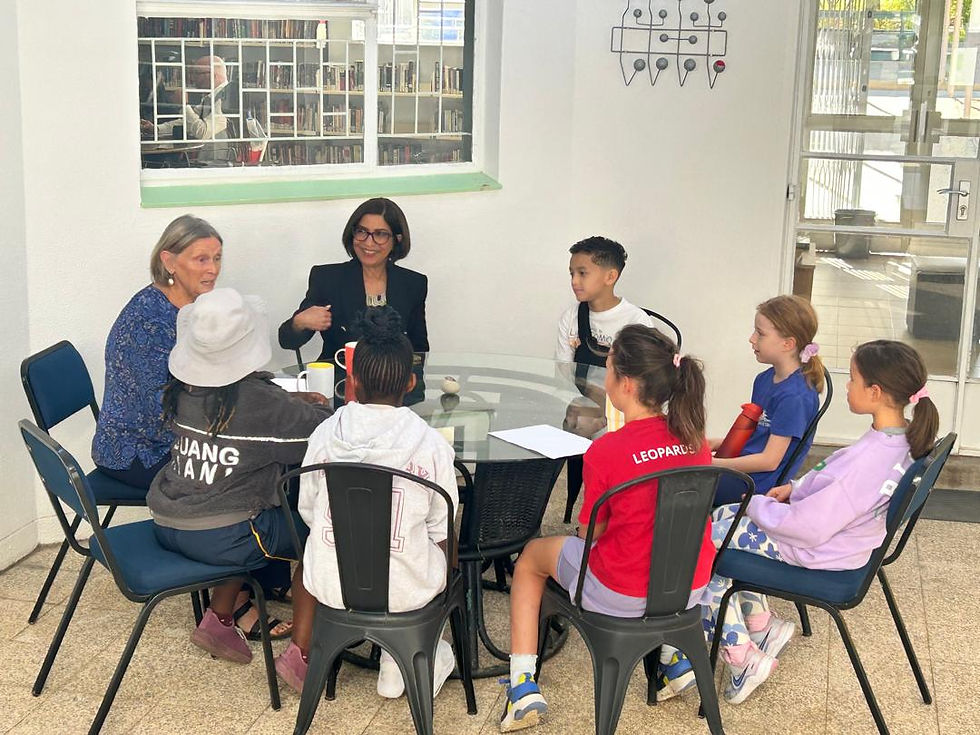
WIS has been accredited by the New England Association of Schools and Colleges (NEASC) since the 1990s. During the last week of September, we were pleased to welcome the visiting re-accreditation team of Diane Ullman, Beatrice Owusu-Boateng, Karuna Datta-Bhatnagar, and Howard Thiery.
The team conducted more than 50 classroom observations and a dozen stakeholder meetings to explore the extent to which WIS is living out its mission: “To develop the full potential of each student in a stimulating environment of academic excellence, cultural diversity and active social responsibility to become internationally-minded independent thinkers.”
The team shared how impressed they were by WIS and the significant progress we have made since our previous accreditation visit. In their concluding remarks, they highlighted the warmth and care evident in students’ interactions, the relevance of our curriculum to the Namibian context, and the pride students take in their school and the ownership they demonstrate over their learning.
The team left us with a metaphor for the next stage of our journey: rock climbing. NEASC’s Foundation Standards and Learning Principles provide a framework for continuous improvement. With this accreditation visit complete, we can turn our attention to the next pitch. We will secure our progress, clip in, and continue climbing toward greater heights. Each pitch gives us a stronger foundation for the next, while the NEASC standards act as pitons, anchoring our efforts and helping us navigate the challenges ahead.
We are proud that WIS played an integral role in the initial formulation of the IB Learner Profile in the 1990s. Today, its attributes and dispositions guide millions of students around the world. WIS already has a global influence, but the NEASC team challenged us to consider what our next contribution might be. Perhaps the next stage of our journey will lead us toward a new and distinctive landscape: not simply a broad plateau marked by the ten attributes of the IB Learner Profile, but a striking spire with two or three defining pinnacles that make WIS unmistakably WIS.
Diane Ullman invited us to imagine what might stand at the summit of that spire: a lighthouse. As she put it, “The world needs more ‘WIS kids.’”
Our current Strategic Plan provides direction through the 2027–28 school year. Looking beyond it, the NEASC team challenged us to think not just about the inputs that shape our work, but about the impact we want to achieve through our next strategic plan. Our challenge and opportunity is to identify the distinctive pinnacles we want WIS to stand for, then climb toward them with purpose, one pitch at a time, through the learning experiences and teaching practices we bring to life every day.
We thank the NEASC visiting team for helping us see our mountain differently, challenging us to imagine what lies ahead, and offering to support us as we continue the climb. The next pitch awaits.


Comments